


Warehouse Health and Safety with A-SAFE: Improving Warehouse Protection Standards
Warehouse health and safety is not limited to policies, training, or PPE. In operational environments, it is fundamentally shaped by how effectively people, racking, vehicles, and infrastructure are protected from everyday risk. A-SAFE impact protection systems play a central role in strengthening warehouse protection standards through engineered polymer safety barriers and racking protection solutions.
Contents
Understanding Warehouse Health and Safety in Operational Environments
An effective approach to warehouse health and safety considers how the space functions in real time.
From an HSE warehouse perspective, risk reduction often centres on:
- Safe traffic management
- Clear pedestrian segregation
- Structural integrity of pallet racking
- Protection of critical infrastructure
- Prevention of avoidable impact damage
While procedures and training are essential, physical warehouse protection systems play an equally important role. Barriers, guards, and impact protection solutions are designed to reduce the consequences of contact between vehicles, racking, and structures.
When these systems are designed into layouts early, warehouse health and safety becomes embedded in the environment itself.
A-SAFE Polymer Safety Barriers and Warehouse Protection Systems
Modern warehouse protection increasingly relies on materials engineered to manage energy rather than simply resist it.
A-SAFE polymer safety barriers are designed to flex, compress, and reform following impact. Built from advanced materials such as Memaplex™ polymer, these systems incorporate controlled compression chambers and built-in memory to absorb force and recover shape after collision.
Key characteristics include:
- Energy absorption ratings tested in controlled environments
- Recovery after repeated impacts
- Reduced force transfer to floor fixings
- Corrosion resistance and chemical stability.
- Long-term durability in high-traffic areas
For example, certain rack end barrier systems have been tested to absorb thousands of joules of impact energy, equivalent to contact from industrial vehicles operating at typical warehouse speeds. Pedestrian barrier systems are engineered to absorb a significant proportion of impact force, reducing stress on surrounding infrastructure.
This form of warehouse protection helps protect:
- Racking structures
- Structural columns
- Machinery and charging equipment
- Pedestrian zones
By dissipating energy at the point of contact and reducing structural strain, polymer systems contribute to a safer, more resilient operational environment that supports long-term warehouse health and safety.
Pallet Rack Safety and Warehouse Racking Safety
Pallet rack safety is central to warehouse racking safety.
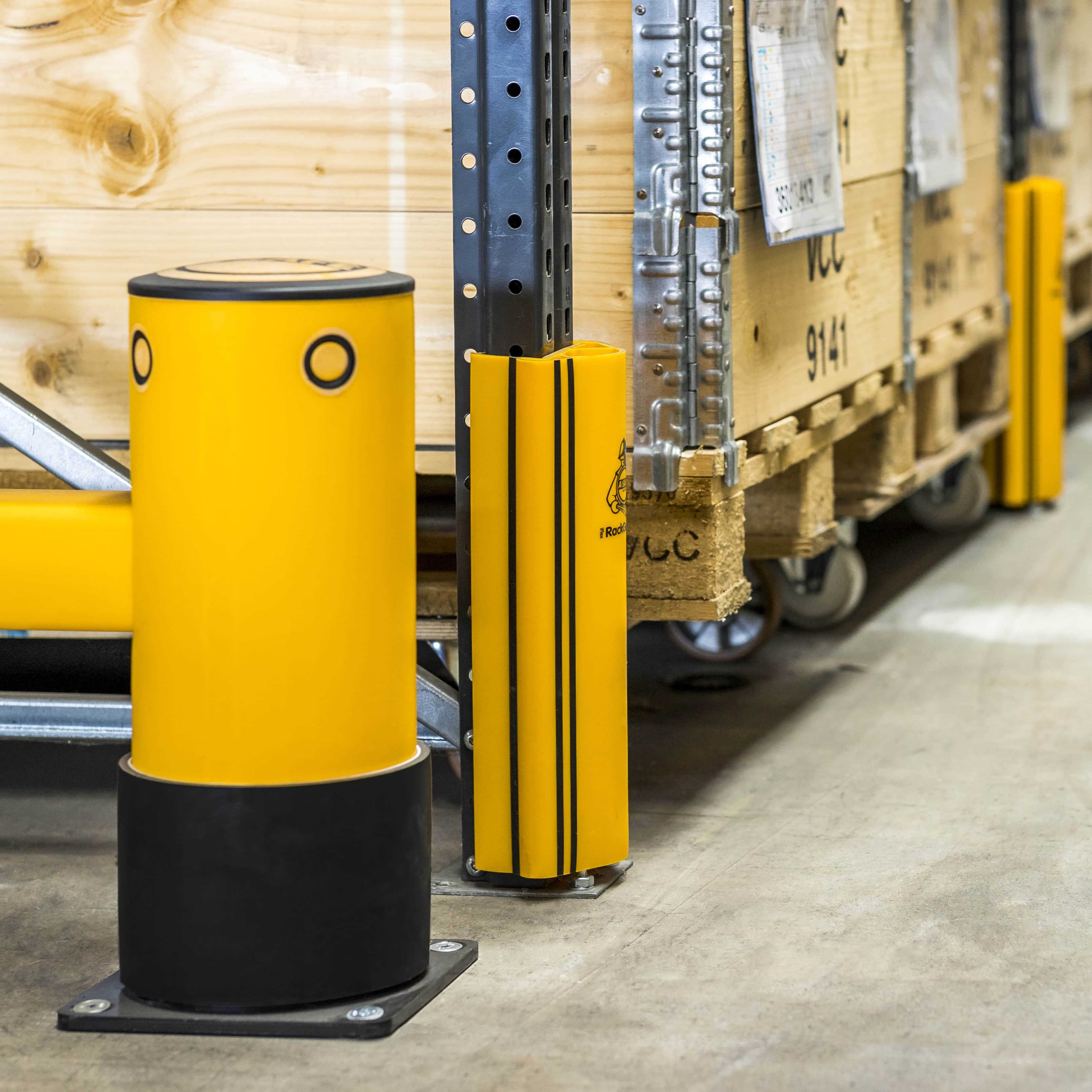
Racking structures are designed to carry significant loads, but they remain vulnerable to impact at upright level and at aisle ends. Repeated low-level collisions from forklifts, pallet trucks, and order pickers can compromise structural integrity over time if left unprotected.
Pallet racking protection and racking protection barriers are used to shield:
- Upright frames
- Base plates and floor fixings
- Rack end frames exposed to turning vehicles
- Aisle entry points
Racking safety barriers and upright protection systems absorb and redirect impact forces from structural components. Protecting the base of the rack reduces repairs, minimises downtime, and supports long-term racking safety.
Protecting pallet racking is not just about preventing damage. It maintains load-bearing performance and reduces risk to nearby workers.
Warehouse Safety Barriers and Workplace Safety Barriers
Segregation is one of the most effective methods of improving warehouse health and safety.
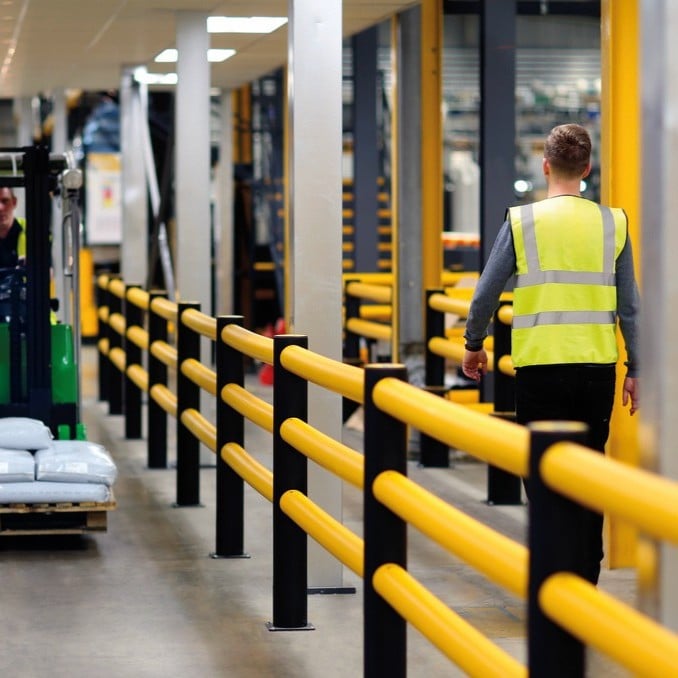
In environments where pedestrians and vehicles operate in close proximity, warehouse safety barriers and workplace safety barriers create clear physical separation between high-risk zones and foot traffic areas.
These systems are commonly installed to:
- Define pedestrian walkways
- Protect charging areas
- Shield goods holding zones
- Separate forklift routes from operational areas
- Safeguard entrances and access points
A-SAFE high-strength polymer barriers are engineered to absorb and dissipate impact energy, protecting pedestrians and vehicle operators in shared environments.
Multi-rail pedestrian barriers cushion and deflect impacts, reducing injury risk and stress on floors and fixings.
Protecting Infrastructure: Columns, Walls, and Critical Assets
Warehouse health and safety also depends on protecting the building itself.
Columns, wall edges, door frames, and structural supports are regularly exposed to contact from pallet trucks and forklifts. Damage to these elements can lead to costly repairs and operational disruption.
Column and corner protection systems are designed to:
- Enclose and shield structural supports
- Protect base fixings
- Deflect fork contact
- Minimise intrusion into usable space
Low-level protection systems, such as kerb-style barriers and step guards, are particularly effective in charging zones and pedestrian crossover areas. These systems help deflect shallow-angle impacts and prevent pallets or forks from encroaching into designated walkways.
By protecting both infrastructure and equipment, warehouse protection systems contribute to improved operational continuity and reduced maintenance costs.

Designing Warehouse Protection Into Your Safety Strategy
Improving warehouse health and safety is not a reactive exercise. It requires planning.
Designing warehouse barriers, racking protection systems, and impact management solutions into layouts at the specification stage helps reduce long-term risk and improve operational performance.
A considered approach to warehouse protection should assess:
- Traffic flow and vehicle types
- Pedestrian interaction points
- High-risk turning zones
- Rack end exposure
- Column vulnerability
- Goods holding and charging areas
By integrating pallet racking protection, racking safety barriers, polymer safety barriers, and workplace safety barriers into a cohesive strategy, warehouses can protect people, infrastructure, and operational efficiency simultaneously.
At QTS, A-SAFE solutions form part of our wider Safety and Signage offering, enabling us to support customers with protection systems engineered to perform in demanding environments.
Warehouse health and safety is strengthened when protection is built into the environment itself, not treated as an afterthought.
Learn more about our partnership with A-SAFE
Share This: