


Warehouse Mezzanine Stairs: Design, Safety and Compliance Explained
Warehouse mezzanine stairs are a core component of any mezzanine floor, providing safe, reliable access between levels while supporting day-to-day warehouse operations. Integrated correctly, staircase design influences how efficiently people move through a warehouse mezzanine, how safely tasks are carried out, and how well the overall industrial mezzanine performs over time.
Well-designed warehouse mezzanine stairs play a critical role in safety, compliance, and long-term operational performance. Understanding how staircase design integrates with the wider structure is essential when planning effective warehouse access.
Contents
Why mezzanine stairs should be considered early
Stairs should never be an afterthought. Their position, configuration, and construction all influence how safely and efficiently a mezzanine operates.
Designing stairs as part of the overall mezzanine structure allows access to be planned around real warehouse workflows, space constraints, and traffic levels. This approach helps avoid compromises later in the project, such as restricted movement, poor visibility, or inefficient layouts.
Early integration also supports compliance with relevant standards and regulations, ensuring access systems are suitable for daily use in demanding environments.
Designed for daily use in warehouse environments
Warehouse mezzanine stairs are subject to high foot traffic and repetitive use. Unlike occasional access stairs, mezzanine stairs must withstand constant movement while maintaining safe, consistent performance.
Key design considerations include:
- Adequate tread width to support safe movement
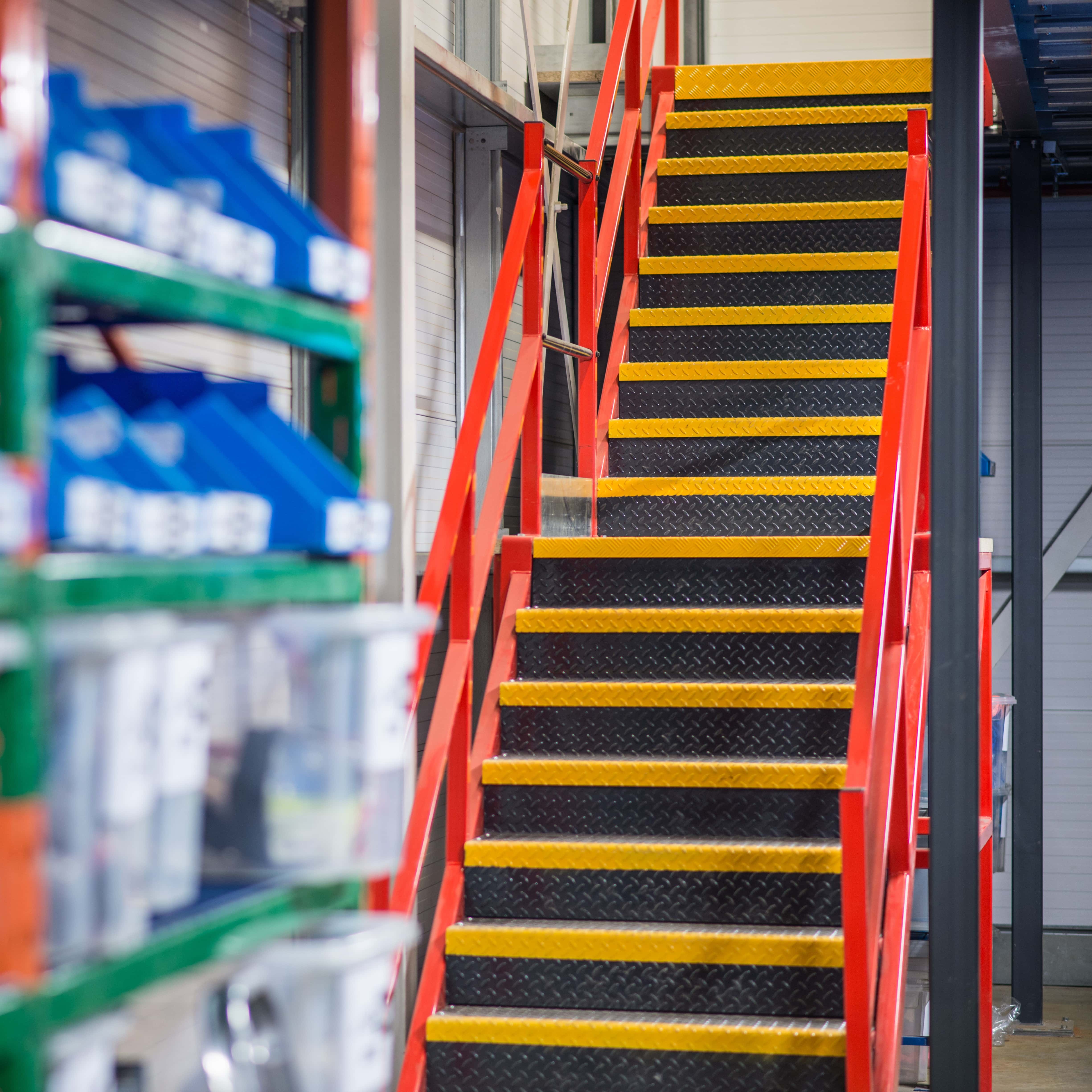
- Clear visual edging to improve step visibility
- Durable materials suited to industrial environments
- Stable handrails and toe boards to reduce risk
HiStore stairs are engineered with these demands in mind, supporting safe access across busy warehouse operations without compromising durability.
Compliance that supports safety and confidence
Warehouse mezzanine stairs must meet specific regulatory and structural requirements to ensure they perform safely over time. This includes compliance with Building Regulations Part K and Part M, which govern stair geometry, handrails, guarding, and accessibility considerations.
Structural performance is also governed by BS EN 1991-1, which defines loading requirements to ensure stairs can safely accommodate expected use.
Compliance is not simply about meeting minimum standards. It provides reassurance that access systems have been designed and manufactured to support real-world use, helping protect people, assets, and operations long after installation.
Tailored stairs solutions for real layouts
No two warehouses operate in the same way. Stair design needs to reflect layout constraints, traffic flow, and how the space is used day-to-day.
HiStore stairs are available in a range of configurations, including straight-run, U-shaped, L-shaped, dogleg, tiered, and ambulant access designs. Finishes can be selected to suit both the environment and the application, with options such as galvanised or powder-coated steel and chequer plate treads.
Additional features such as custom balustrades, mid-landings, handrails, toe boards, and high-visibility step edging help ensure stairs integrate seamlessly with mezzanine structures while supporting safe access.
Access designed into the structure
Effective mezzanine stairs should do more than provide a route between levels. They support safety, usability, and long-term performance across warehouse environments.
By designing stairs as an integral part of the mezzanine structure, access can be aligned with workflow, compliance requirements, and operational demands from the outset. This approach helps ensure mezzanine systems function safely and efficiently throughout their lifespan.
To find out more about staircase solutions designed to integrate with mezzanine structures, explore HiStore stairs
Share This: